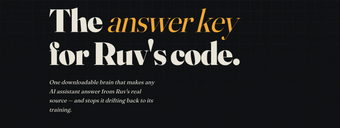
Source-grounded MCP server for RuvNet AI assistants
ruvnet-brain, developed by Stuinfla, is an MCP server that grounds AI assistants in the RuvNet codebase. It supplies models with concrete repository and documentation references so they produce answers tied to real source material rather than unconstrained guesses. The app connects AI assistants to a maintained corpus, offers rapid retrieval of relevant source chunks, and updates itself automatically. The target users are developers and AI engineers building on the RuvNet stack who require verifiable coding assistance.
What tasks can you actually use it for?
The tool acts as an instruction manual for agents working specifically on the RuvNet ecosystem, giving model queries direct access to in-repo artifacts. It provides grounding for modules such as RuVector/RVF, Ruflo, AgentDB, RuLake, and SPARC, so agents can retrieve implementation snippets and documentation excerpts while authoring or reviewing RuvNet codebases.
How reliable are the model outputs when using it?
Outputs are source-grounded because the server forces models to reference actual code and documentation, reducing hallucination risk with a verifiable answer key. Retrieval uses HNSW-indexed pattern storage for fast matching of source chunks, and the project claims noticeable retrieval speed gains compared with standard retrieval-augmented generation approaches.
What inputs and setup does it require?
Installation requires a Node.js environment and is delivered via npx ruvnet-brain, which also supports nightly automated updates. The server connects to local or remote knowledge bases and integrates with MCP-compliant hosts. Typical compatible hosts include:
- Claude Code
- Claude Desktop
- OpenAI Codex
Is it suitable for multi-agent and production workflows?
The design supports multi-agent orchestration with shared state and memory, enabling parallel agents to collaborate over the same grounded corpus. That capability fits complex developer workflows in the RuvNet stack, though it depends on an MCP host and an operational Node.js runtime to run continuous or coordinated agent sessions.
Clear specialist choice for RuvNet engineers, not a general coding assistant
For developers and AI engineers working inside the RuvNet ecosystem, the tool is a focused option that narrows model outputs to the project's verified corpus and reduces unsupported guesses. For teams that need cross-stack or non-RuvNet assistance, the tool's narrow alignment to RuvNet makes it less appropriate. Expect to pair its outputs with human review for critical decisions.